.svg)


Key Takeaways
- Validated benchmarks use peer data that has been standardized, normalized, and quality-checked to ensure true comparability — not just aggregated averages.
- They matter more than ever as SaaS leaders need to make high-stakes decisions with less margin for error.
- Leading teams use validated benchmarks rather than generic, widely available data to align stakeholders, reduce friction, and move decisions forward with confidence.
Introduction
Benchmarks are only useful if they hold up when decisions are on the line.
In today’s SaaS environment, assumptions break quickly. Plans are revisited mid-year. Boards ask harder questions earlier. Yet many finance teams still rely on benchmarks that appear precise but don’t withstand scrutiny — whether due to inconsistent definitions, mismatched peer sets, or unreviewed data — introducing friction exactly when decisions need to move fast.
When benchmarks are questioned, progress slows. When benchmarks are trusted, teams act.
Validated benchmarks shift the conversation from “Is this data right?” to “What does this mean for our decisions?”
What “Validated” Means in Practice
When we say benchmarks are validated, we’re describing a disciplined review process.
Validated benchmarks are reviewed by a dedicated team with deep expertise in SaaS operating models. Our validation methodology, developed in collaboration with Bain & Company’s Technology practice, is applied consistently to all incoming data before it is included in final benchmark calculations.
In practice, validation includes:
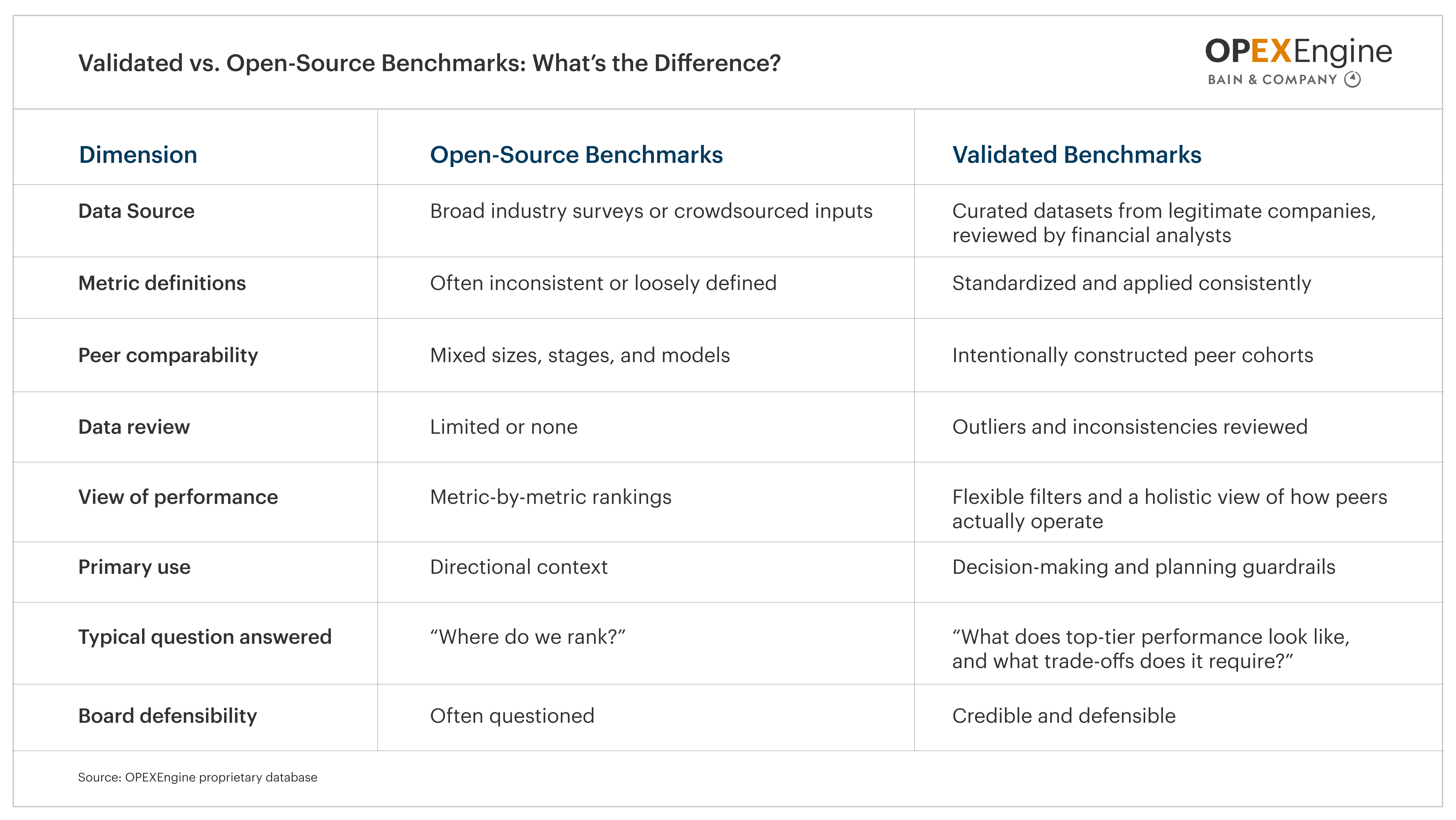
- Standardized metric definitions, so metrics mean the same thing across companies
- Normalization for scale, growth stage, and operating model
- Review of outliers and inconsistencies, rather than blindly averaging inputs
- Intentional peer cohort construction, not algorithmic mashups
This rigor ensures finance leaders are comparing like to like — not signal to noise.
Validation doesn’t make benchmarks perfect. It makes them defensible.
Why Open-Source Benchmarks Break Down in Practice
Most SaaS teams don’t struggle because they lack benchmarks. They struggle because they rely on open-source benchmarks that were never designed to support real operating decisions.
Common breakdowns include:
- Directional industry averages that blend dissimilar companies
- Crowdsourced or self-reported data with inconsistent definitions
- Metric-by-metric leaderboards that ignore operating trade-offs
Open-source benchmarks answer: “Where do we rank?”
Validated benchmarks answer: “How do top performers actually operate, and where should we focus?”
That distinction matters when decisions involve resource allocation, investment, hiring, and long-term risk.
Why This Matters More Than Ever
The need for validated benchmarks has increased as SaaS operating conditions have become more volatile.
Over the past year, finance leaders have faced:
- Rapid shifts between growth and efficiency expectations
- Increased scrutiny from boards and investors
- More frequent reforecasting and scenario analysis
At the same time, benchmark data has become easier to access — and harder to trust. The volume of available data has exploded, much of it inconsistent, outdated, or difficult to compare. Without consistent definitions and quality checks, comparisons fall apart quickly.
When timelines are tight and stakes are high, data credibility is not a “nice to have.”
It is the difference between momentum and paralysis.
“Low-quality data is easy to find, but you get low-quality comparisons. High-quality data — like OPEXEngine — is rare and worth paying for. OPEXEngine is a critical tool for our management team.”
— Jim Lejeal, CFO, Rally Software, SPHERO, Splunk/VictorOps, Absolute Software
How Leading Teams Use Validated Benchmark Data
Teams that rely on validated benchmarks don’t treat them as reference slides used once a year. They embed them into how decisions get made throughout the year.
In practice, leading finance teams use validated benchmarks to:
- Establish clear guardrails for budgeting, hiring, and resource allocation decisions.
Benchmarks define what “reasonable” looks like for a given operating model, helping teams distinguish between intentional investment and emerging risk. - Anchor scenario analysis and plan validation across planning and reforecasting cycles.
Rather than rebuilding assumptions from scratch mid-year, teams use benchmarks as a stable external reference point to pressure-test changes as conditions evolve. - Reduce friction in executive and board discussions — especially during mid-year reassessments.
A shared, trusted benchmark base keeps conversations focused on trade-offs and priorities, rather than debating the data itself.
“We use OPEXEngine to benchmark how we are doing against our peers. We use it to set targets, and when questions come up from operating departments. OPEXEngine does the hard work of aggregating data, cleaning it, and then providing it back anonymously.”
— Kerman Lau, Vice President, FP&A, Workday / Adaptive
Used this way, validated benchmarks become an operating asset, not a point-in-time comparison.
How OPEXEngine Can Help
OPEXEngine provides SaaS benchmarking data that finance and operations teams can trust.
Our approach combines validated data, consistent definitions, and highly relevant peer comparisons so teams can move forward with confidence — especially when decisions can’t wait for the next planning or reforecasting cycle.
Final Thoughts
In a volatile environment, speed matters — but only when paired with credibility.
Validated benchmarks give finance leaders a reliable external lens — one that supports better decisions, stronger alignment, and greater resilience when conditions shift.
Want to Learn More?
Read more about our validated benchmarks
See how OPEXEngine delivers trusted peer data