.svg)


The first post in our series of insights from OPEXEngine’s 2026 benchmark release.
At a Glance
- Revenue growth continues to flatten, particularly among SaaS companies in OPEXEngine’s proprietary benchmark database, building on the stabilization trend we observed last year.
- Smaller SaaS companies with less than $100M in revenue showed signs of growth stabilization in 2025, while larger companies continued to reflect broader market growth moderation.
- Larger SaaS companies with more than $100M in revenue showed clearer margin improvement, suggesting they are finding operating leverage even as growth remains slower.
- Large public SaaS companies in the BVP Nasdaq Emerging Cloud Index also showed continued growth moderation, though the pace of decline appears more moderate than in prior years.
A Note on Methodology
OPEXEngine produces benchmarks on 250+ SaaS operational and financial metrics, based on annual data from participating software companies. Data is validated by OPEXEngine's team working directly with each company, and all submissions are confidential and anonymized.
This article draws on OPEXEngine’s proprietary benchmark database and compares select trends in our majority private company database to publicly available data from the BVP Nasdaq Emerging Cloud Index.
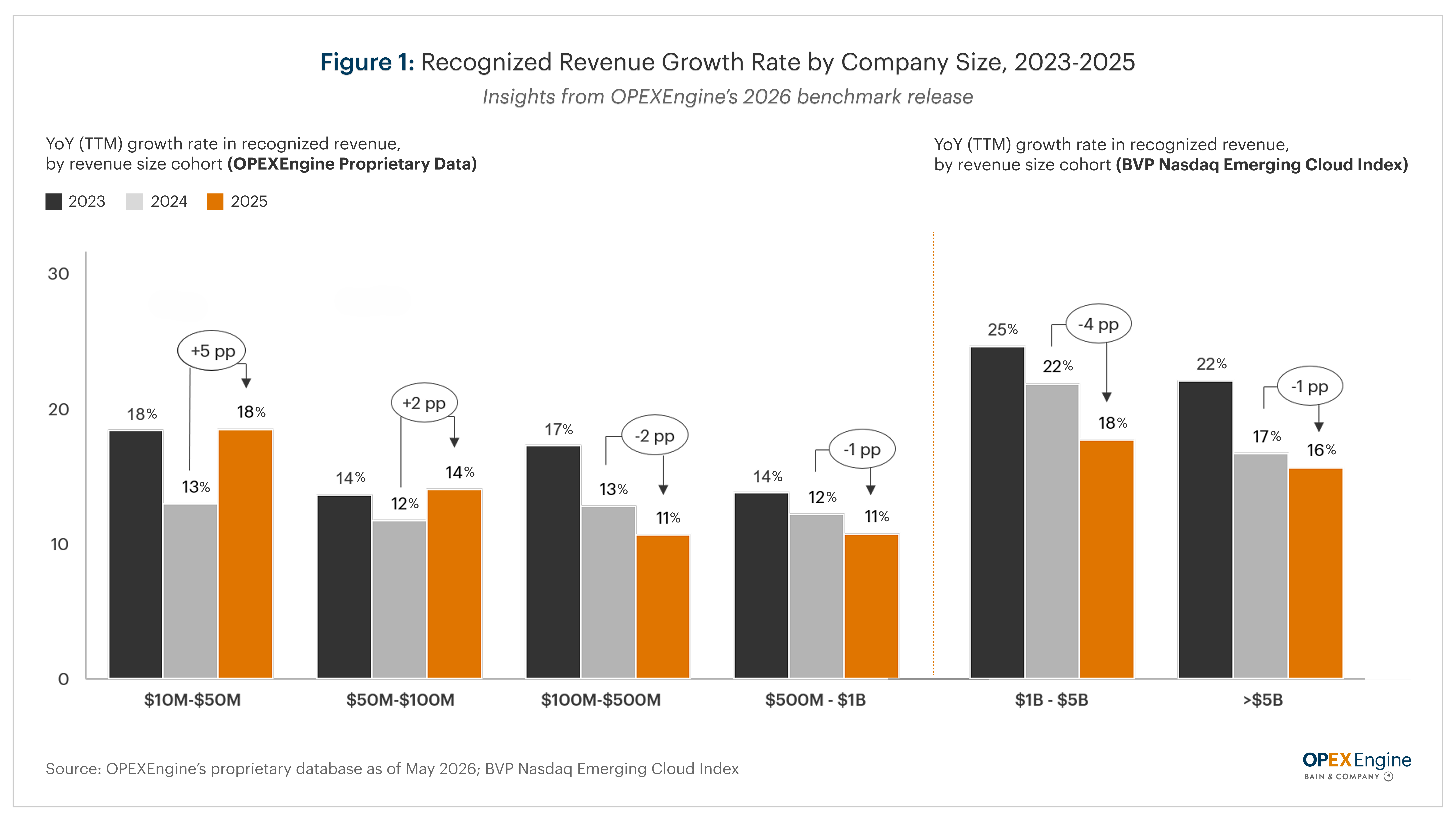
For the past three years, the SaaS growth story has been a single, consistent line: down. OPEXEngine’s latest benchmark data disrupts that narrative, but not uniformly. We’re observing a SaaS market that is still operating in a slower-growth environment, but with signs that the pace of deterioration is slowing.
The clearest takeaway is that performance is improving in different ways by company size. Smaller SaaS companies are showing signs that revenue growth declines may be flattening: the $10M-$50M cohort grew 18% in 2025, back to 2023 levels and up from 13% in 2024; the $50M-$100M cohort returned to 14%, up from 12%. Larger companies in OPEXEngine’s proprietary database, by contrast, continue to face slower growth, with the $100M-$500M cohort declining to 11% from 13% in 2024 and 17% in 2023, but are showing more pronounced margin improvement.
Smaller companies may be beginning to regain some growth stability, while larger companies appear to be responding to continued growth pressure by accelerating margin improvement.
The recovery in smaller companies is likely driven by their operational agility: repricing quickly, shifting sales motions, and pursuing AI transformations without the coordination costs of a larger organization. As enterprise buying conditions gradually stabilize, these smaller companies may simply be the first to benefit.
Public SaaS Benchmarks Show Continued Growth Moderation
Among larger public software companies, the BVP Nasdaq Emerging Cloud Index tells a consistent story. The $1B-$5B cohort grew 18% in 2025, down from 22% in 2024. Companies above $5B grew 16%, down from 17%.
The magnitude of decline is smaller than in prior years; both cohorts dropped only 1-4 percentage points in 2025, compared to steeper drops from 2023 to 2024. Though the direction remains the same: continued moderation, not acceleration.
Together, the public and proprietary data point to a market that has not yet broadly re-accelerated. Smaller companies appear to be recovering earlier, while larger companies, public and private, are still working through slower growth.
Profitability: Larger Private Companies Show Clearer Margin Improvement
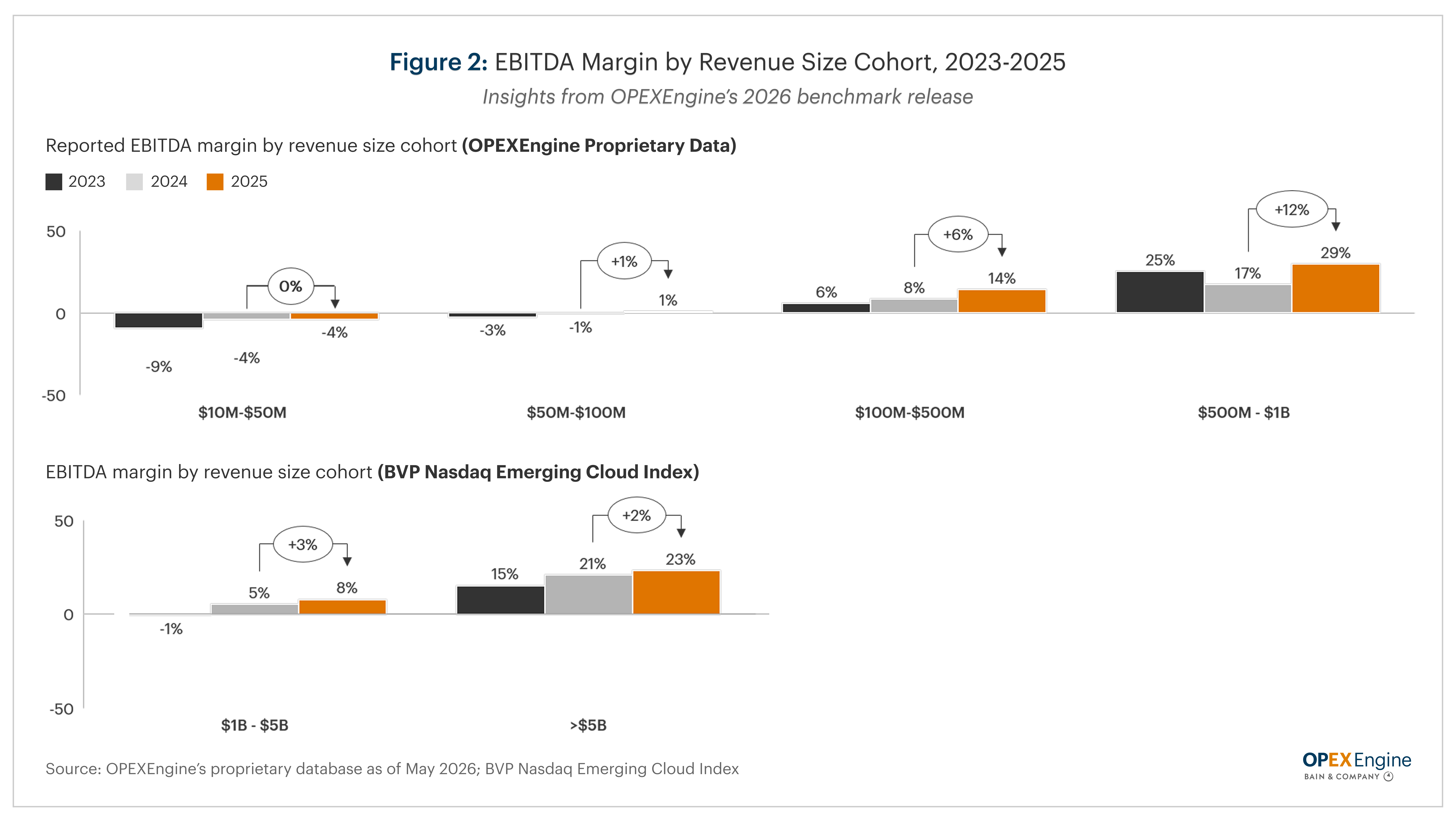
The profitability picture, however, inverts the growth story. Smaller SaaS companies showed minimal margin improvement. The $10M-$50M cohort maintained margin at approximately -4%, while the $50M-$100M cohort improved modestly from -1% to 1%.
Larger companies moved much more decisively. The $100M-$500M cohort improved EBITDA margin from 8% to 14%, while the $500M-$1B cohort improved from 17% to 29%.
These are meaningful shifts, and they likely reflect several converging forces: continued expense discipline, which we will explore in depth in our next post, and more favorable operating leverage as revenue scales. This trend may also be influenced by the majority private company composition of OPEXEngine’s proprietary database. Private companies can often make more significant operating changes with less quarter-to-quarter scrutiny on topline growth.
Public-Company Profitability Also Reflects the Focus on Efficiency
The BVP Nasdaq Emerging Cloud Index shows a similar direction among public companies, though with smaller margin improvements. But the direction is consistent: profitability is improving at scale, and larger companies are prioritizing margin even as revenue growth stays under pressure.
What This Means for SaaS Operators
The latest benchmark data doesn't describe a single SaaS recovery. It describes two.
Smaller SaaS companies’ growth is recovering: growth rates bounced back in 2025 after a sustained decline, and the gap between 2023 levels and 2025 levels has effectively closed for the $10M-$50M cohort. These companies are likely competing in markets where conditions are improving, and their agility is helping them capitalize faster.
Larger SaaS companies’ profitability continues to improve: EBITDA margins expanded sharply, and the $500M-$1B cohort now sits at 29%, a level that reflects genuine operating leverage. Growth remains slower, but margin improvement is providing a credible alternative performance narrative.
One practical implication is that any benchmarking comparisons should be done against the right peer group. A $30M company that improved growth from 13% to 18% is doing something different from a $400M company that held growth at 11% while expanding margin by 6 points, and both are likely outperforming companies that didn't move meaningfully in either direction.
The SaaS market isn't returning uniformly to prior growth conditions. It's entering a phase in which growth stability and margin improvement both matter, but which one matters more depends heavily on your growth stage.